

Collect documents throughout term
A premium audit, also known as a final audit, is a standard practice where your workers’ compensation policy is reviewed after the term ends to ensure that the premium accurately reflects the exposure for your company over the policy period.
It’s important to us that your audit process is as smooth and convenient as possible. Check out this video to learn more about what to expect and how to prepare.
A premium audit is standard practice for insurance policyholders that helps ensure your premium is based on accurate, up-to-date information about your business. Your workers’ compensation policy was originally issued using estimated payrolls for the policy period.
During this final review process, we gather the actual payroll figures to finalize the policy for the concluded policy period. Even if you reported monthly payroll during the policy period, a final audit is still needed to close the term.
At the end of your policy period, our premium audit team will contact you with an invitation to complete your audit online or in-person. How your audit is completed depends on premium size, type of operation, and state requirements. We want to make this process as seamless as possible for you and will do our very best to arrange a date and time that best accommodates your schedule and the auditor’s availability.
Once the audit is complete, you’ll receive an invoice displaying the premium calculations based on actual payroll figures as shown in the audit. This invoice may show a refund or that money is due once actual payroll figures are calculated.
For more information on what to expect and how to prepare for your final audit, see our article on Conducting Your Workers’ Compensation Audit with Ease.
Take a look at a typical premium audit process timeline.
Collect documents throughout term

Policy term ends

Receive audit notice

Gather remaining documents

Complete audit with auditor

Review results

Receive final invoice or credit
 Workers’ comp audit requirements that may be requested
 Detailed payroll records
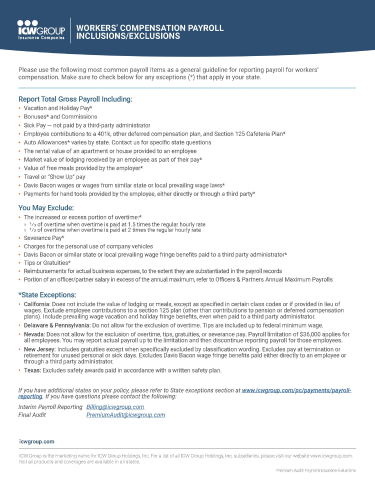
 Additional payroll items
 Subcontractor or casual labor information*Tax information
* Please note that as your partner in risk, it’s important we help verify coverages for non-employees such as subcontractors and temporary labor, therefore you will see items on this list that clarify where those exposures might fall. If you have questions about what constitutes an independent contractor, please see our FAQ below.
After the audit, we will send you an invoice displaying the premium calculations based on actual payroll figures as shown in the audit. The Final Audit Invoice reconciles what you’ve paid based on your policy estimates or monthly reported payroll. It will either show a refund or that money is due once actual payroll figures are calculated.

|
Pay & view invoices online | myresource.icwgroup.com | 877.289.1644 |

|
Payment assistance | AR@icwgroup.com | 858.350.7262 |

|
Invoice questions | billing@icwgroup.com | 858.350.7399 |

|
Monthly payroll reporting | support@smartpayllc.com | 877.905.0786 |

|
General questions | premiumaudit@icwgroup.com | 858.350.2933 |
A premium audit is a standard practice where your records are reviewed to ensure that the premium for your workers’ compensation policy accurately reflects the exposure for your company over the policy period.
A premium audit is standard practice for insurance policyholders that helps ensure your premium is based on accurate, up-to-date information about your business. Even if you reported monthly payroll during the policy period, a final audit is still needed to close the term. The expectations for audits are laid out in item 5 G of your policy, which states:
“You will let us examine and audit all your records that relate to this policy. These records include ledgers, journals, registers, vouchers, contracts, tax reports, payroll and disbursement records, and programs for storing and retrieving data. We may conduct the audits during regular business hours during the policy period and within three years after the policy period ends. Information developed by audit will be used to determine final premium. Insurance rate service organizations have the same rights we have under this provision.”
This is a standard practice for all policyholders. Your policy premium was based on information provided by you and/or your agent when the policy was issued. This included the estimation of your company’s payroll as well as employee job classifications. Payrolls or business operations could have changed over the policy period and the premium audit will review and compare your company’s actual payroll and business operations to the original estimates, endorsements, and any payroll reported throughout the policy period.
No, state regulations and the policy issued to your company require us to conduct annual premium audits. Many states have adopted audit non-compliance rules and additional charges if the audit is not completed. These potential charges are a part of your policy. Because an audit is a standard practice for all insurance companies that provide business insurance coverage, the workers’ compensation audit process is routine for an insurance company. Please note that a premium audit is required for all workers’ compensation policies regardless of whether the policy has been renewed, cancelled, or moved to another carrier.
We definitely want to work with you to get the documents ready for the audit and are here to help. Please contact us at premiumaudit@icwgroup.com.
Because audits are required, we will need to continue with your final audit. In most states, there are state statutes or Workers’ Compensation Bureau rules that allow the estimate or non-compliance charge to be up to three times the original Estimated Annual Premium. In addition to the estimate, your current coverage may be subject to cancellation. All of this will also affect your Ex-mod calculation.
We want to obtain the requested information so that we can process the final audit correctly without any estimates or cancellations. If you assist our auditor by providing the requested records and information, they can ensure you receive all available credits and discounts, so your premium accurately reflects your exposure – no more and no less.
After the final audit has been done at your office, you’ll receive a final audit invoice within 30 days. This invoice will reconcile what you’ve paid (including your original deposit) based on your estimates or your monthly reporting. If you have any questions, please feel free to call us at 858.350.7399 to review the invoice or the audit information.
An accurate audit will depend on the accuracy and completeness of the records provided for the audit. There are two ways to help ensure accurate and complete records.
The list of workers’ comp audit documents below is typical for most companies. However, the auditor may request additional information to properly complete the audit for your company. If there are multiple named insureds listed on your policy, the auditor requests this information for each company.
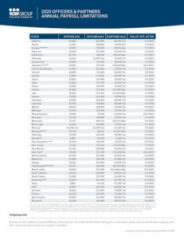
Your payroll report should contain all employees paid within the audit period, including any employees who are no longer working for the company. Rules will vary by state, but the auditor will advise if there are specific additional items required in your state. Generally, the following items should be listed in the report:
We ask for additional financial records to determine any possible workers’ comp exposure not included in your payroll records. For example, a sales breakdown ensures that the proper workers’ compensation class code(s) is applied to your company operations.
The auditor will only ask for documents they need to complete the audit, including certain tax records such as federal 941 quarterly returns, state unemployment returns (SUTA), 1099’s, 1040 (Schedule C), 1120, 1065. All of your information is kept strictly confidential and only used for verification of the audit records.
The auditor must review information from a primary source document such as the payroll reports and validate these amounts by comparing them to a verification document such as the quarterly tax reports or financial statements.
The auditor may request items outside the policy period dates for reconciliation purposes. For example, the auditor may request dates which are for a full month as opposed to the specific dates listed on the policy. While the policy period may be 05/13-05/13, the auditor may request 05/01-05/01. A second example might be when verification documents don’t line up exactly with the policy period. In that case, the four quarterly reports that most closely align with the policy dates will be requested. Since these dates will differ, the auditor may also request an onset and offset payroll amount so that the reports can be verified to the primary source document. Using the same example, the auditor will request the payroll for the month of May at the beginning and end of the policy. It will then be added and subtracted to reconcile to the quarterly reports.
As your partner in risk, it’s important we help verify coverages for non-employees such as subcontractors and temporary labor. Your profit and loss statements (P&L) are helpful in determining if there are any workers’ compensation exposures not included in your payroll records. They are important for the auditor to review to ensure that any individuals that you used during the year meet the definition of an independent contractor.
Part five: Premium. Specifically, sections C (remuneration #2), F (records) and G (audit).
If you do not wish to provide Profit & Loss statements to the auditor, you can provide:
Please be aware that after reviewing these documents more questions might come up. The auditor would then contact you for this information.
The premium earned for the policy period could change from the estimates established at the beginning of the policy. The audit reviews your actual payroll paid, business operations, employee classifications, officer inclusion or exclusion and the use of sub-contractors, contract laborers or temp laborers. The end result of the audit is to ensure that the proper premium is paid and that you do not pay more or less than you should for the coverage provided.
The rates and rating factors used on your policy (at the beginning and including any changes by endorsement) are the same ones used to calculate the final audit. The one exception is with the premium discount. This is a discount based on the subtotal of the premium, therefore it changes as the subtotal changes. Beginning with page 2 of your final audit invoice, you can see the payrolls used by classification code.
Your final audit calculates the actual premium for your policy and subtracts that from payments that you have made. These payments include the deposit, endorsements, midterm payroll pay-as-you-go payments and installments.
An insured is considered noncompliant if the audit is not completed or if the insured refuses to allow permission to review audit records. Multiple states have adopted an audit noncompliance policy and charges. The audit noncompliance charge will vary by state, consult your workers compensation policy and endorsements, or contact your agent to find out more about your specific state’s policy.
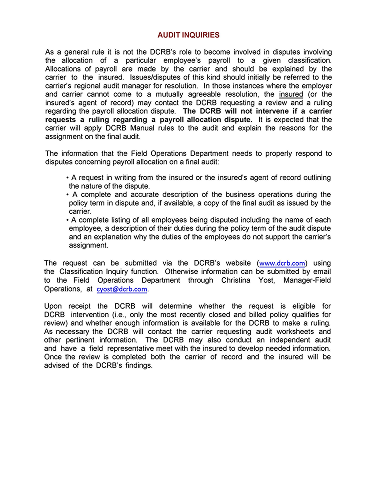
If necessary, we will place the billing in dispute while we investigate further and make any necessary corrections or adjustments. Once we receive your information, we’ll review the audit and billing. We’ll also compute any amounts that are still due based on the “undisputed” portion of your billing. Undisputed amounts will still be due in accordance with the original invoice.
We strive for 100% accuracy on your audits and invoices. As you review your final audit invoice, please let us know right away if you find any discrepancies or disagree with the findings by contacting premiumaudit@icwgroup.com and providing as much detail as possible.