
Rising claim severity has dominated California workers’ compensation news for several years now and has yet to abate. As severity continues to grow and often results in higher rates for employers, policyholders have become increasingly invested in understanding what’s behind this shift and what can be done about it. We sat down with ICW Group Chief Claims Officer, Lynn Moretti, and Chief Underwriting Officer, Commercial Lines, Paul Zamora, to understand how attorney involvement drives the trend and how employers and carriers can get ahead of this rising tide in a hyper-litigious environment.
Litigation Leading the Charge
With the California Insurance Commissioner approving an 8.7% increase in the pure premium rate for workers’ compensation as of September 1, 2025, delving into what’s behind this turn decision is a hot topic industry wide. The rate hike is largely reflective of an increase on the expense-side of the claim–mostly driven by increased attorney involvement and the resulting repercussions.
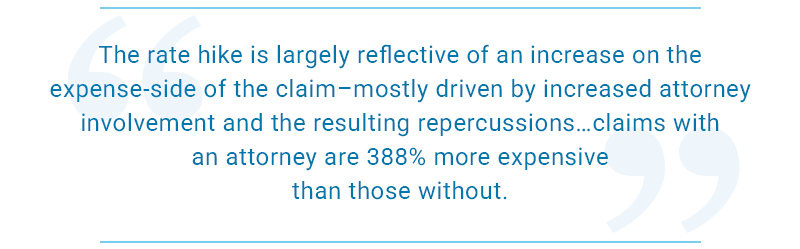
One comprehensive study showed that claims with an attorney were 388 percent more expensive than those without attorney representation. Plus, median costs increased by 739 percent once attorneys got involved. However, these increases in costs do not actually correspond to increases in medical complexity or increased duration of average weekly wage payments. Why? Because frictional costs will have increased around additional claiming activity, activity with minimal medical, or indemnity benefits.
The most prevalent example is the rising rate of cumulative trauma claims in California. A cumulative trauma, or CT claim, is a workers’ compensation claim for injuries that develop gradually over time due to repetitive, work-related physical or mental stress–rather than a single, sudden accident (known as a specific injury). For example, a worker might report a specific knee injury, but the claim can also include cumulative trauma, so the suggestion is that the condition may have developed or been aggravated over time due to repetitive work activities, not just a single incident.
Los Angeles Basin accounts for the highest concentration of the growing surge of California CT claims, driven by a combination of workforce demographics, industry mix, and legal framework. California law allows a claim to be considered compensable if work contributes even minimally to the injury– just 1% exposure. According to WCIRB data, California CT claims are a major driver of the number of workers’ compensation claims, accounting for 21.8% of all claims in 2023.
Zamora highlighted that this wave is being driven by attorney involvement. “Most CT claims, if not all, have attorney involvement in them,” he explained. “Injured workers don’t generally add CT on their own, it usually comes into play when being advised by an attorney.” Once that happens, there is almost always an increase in expense related to litigation.
“That’s why allocated loss adjustment expense has been going up steadily,” Zamora added. These costs associated with attorney involvement, like expert witnesses, investigators, independent medical examiners and the like, are needed once the claim becomes litigated.
“Then we are seeing increases in medical (up 9% in 2024) as well, which you generally see on a litigated claim because litigation often involves expanded medical evaluations and additional treatment requests, which can increase overall medical costs and ultimately impact the value of an award.”
The Spread of LA Law
Previously a Los Angeles problem, these types of costs are now going up a good deal in Northern California and elsewhere in the state as well. “Claims used to be quite high in LA,” Zamora said, “and not as much in San Diego and Northern California. But one of the adverse effects of COVID that we’re seeing is that you were allowed to do remote hearings and that’s still happening today. So, a larger number of attorneys from LA are now representing injured workers from San Diego, the Bay Area, or Sacramento and that’s driving up some of those costs as well.”
Another big factor is what’s sometimes referred to as geographic arbitrage, which is a term for venue changes with these types of court cases. Zamora explained: “These LA lawyers are also trying to change the venue to get the actual case heard in LA.” In a state already known for its litigious liabilities, the city of Los Angeles is considered the epicenter of higher-value claimant awards.
The Communication Solution
So, what can be done about the litigation-driven severity of workers’ compensation claims in California? According to Moretti, it comes down to basic claims expertise. “Our claim professionals prioritize great communication and keen investigation,” she said, explaining that it’s important to work hard to build trust right away to make it clear from the beginning that the carrier is on the case and cares about your best outcomes. After all, seeing an injured worker obtain the right treatment and get back to work as soon as they are well is in all parties’ best interest.
“That’s why we’re speaking to the injured worker before they ever feel the need to contact counsel,” she said. “We earn their trust right off the bat and begin to do right by them from the start–handling their claim effectively and communicating with them every step of the way. In our business, we are faced with injuries each and every day, at every degree of severity. It takes a level of expertise to guide the injured worker through the process with care and empathy.”
Moretti stressed the importance of claim professionals at ICW Group making contact with the injured worker, employer, and the medical provider within 24 hours of a claim being reported. This “three-point contact,” according to Moretti, paired with a hard five-hour rule where all calls are returned by a human being within five hours, ensures injured workers know they are in good hands.
Solid Internal Teams on the Case
Another beneficial approach Moretti pointed to is having a claims triage team in place—a feature that is somewhat unique to ICW Group. “Our triage team is a hands-on immediate approach to first notice of injury. This is a highly specialized team, think boots on the ground, who can conduct an immediate assessment and ascertain what involvement is needed from other experts and/or services. This early identification and structured escalation process allows us to apply specialized oversight and avoid unnecessary distraction or expense.”
For the more severe claims, ICW Group Nurse Case Managers work with injured workers and their medical team throughout the claim, ensuring the best treatment protocol. They also offer other resources to all policyholders such as telemedicine and a nurse hotline so a trained professional can determine right away if a workplace injury can be managed with first aid in-house or requires intervention from a medical professional. The Nurse Case Managers then connect the injured worker with the proper level of care.
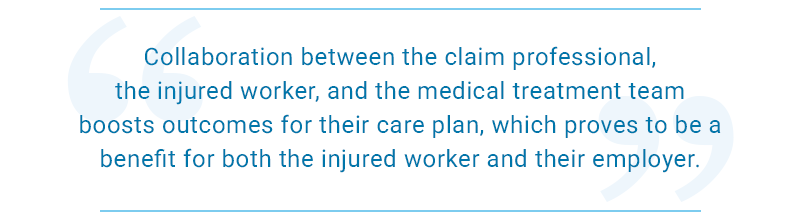
“Through these efforts,” Moretti told us, “injured workers are assured that their carrier has their care at the forefront. This collaboration between the claim professional, the injured worker, and the medical treatment team boosts outcomes for their care plan, which proves to be a benefit for both the injured worker and their employer.”
When it comes to navigating the new litigation landscape in terms of venue changes from other jurisdictions to Los Angeles, both Moretti and Zamora echoed that best practice is for your claims team to have a plan in place before this type of action happens. That way, they can act right away.
“You only have 30 days to respond when a venue change is requested,” Moretti said. “So, it’s important to understand that timing and to employ strategic people with the jurisdictional expertise to know what forms to file and what process to follow.”
It also helps to know what’s coming down the pike. With good data, Moretti explained, you can exercise the best possible decision-making to control outcomes, and the more data the better. “The goal is quality outcomes for injured workers,” she said, “extra time and expense for spurious and ancillary claims does not advance that goal. A streamlined and tactical litigation approach is critical.”
Tech that Works for You
Good data and the role of technology overall is a third, crucial factor throughout the life of a claim. In fact, it starts before an accident even happens, with proactive online risk management tools tailored to the policyholder’s specific industry and needs.
When injuries do occur, it’s important to have your technology working for the injured worker–helping take care of them, never getting in the way. “Our online claims form and injured worker claims portal are designed to serve our customers and field their concerns in a challenging time,” Moretti said. “It’s important to be able to file a claim easily and to know your carrier is being as transparent as possible, keeping you up to date with your claim as the process continues.”
What Can Policyholders Do
At a time when rates in California are beginning to rise, it’s never been more important to look at how to keep the severity of claims as low as possible. The most impactful action an employer can take to reduce exposure is to be as proactive as possible about safety and loss control, because a safe workplace is best for everyone and cuts costs across the board.
Taking full advantage of your carrier’s risk management program is key, as is keeping consistent with safety trainings—perhaps with the help of online learning. If, like ICW Group, your carrier offers on-site safety consults, ask for them. Safety Consultants possess industry-specific expertise and will help you attain a safer work environment.
Technology can come into play here, as well, Zamora noted. He mentioned several programs ICW Group has been piloting to increase workplace safety. One tool allows policyholders to shoot video of workers performing everyday tasks, then upload them to an AI tool that can assess every aspect for ergonomics and safety. “The tool can tell them what’s being done improperly and give advice on how to make the work more ergonomic. For example, if someone is bending too much, the advice might be to do the work on an elevated platform.”
Another pilot program employs smart cameras to capture “near misses” when accidents almost occur, because most severity losses are often preceded by several near misses, but these are almost never reported to higher ups. “If you can catch those on the front end,” Zamora said, “and you know about that near miss immediately, then there are hopefully things you can implement from an employer standpoint so that the near miss never happens again and you avoid that severity loss you would have gotten by not paying attention to it.”
Finally, making sure your carrier has a robust in-house fraud prevention program can also help keep a lid on claim severity. “You’d like to think every claim is legitimate,” Zamora said, “but that’s not always the case, so you need to be sure you’re taking a pretty aggressive approach to fraud and making sure you’re investigating that as much as possible.”
The severity of claims in California is trending high and rates are beginning to reflect that. But this doesn’t mean there’s nothing to be done, even in the face of the cresting wave. In this environment, partnering with a carrier who combines disciplined claims expertise, proactive communication, and data-driven decision-making is more important than ever.
For more information on ICW Group’s Risk Management, Claims, Fraud, or Safety Resources, please visit our site. We’d be happy to help you learn more and see you and your workers get home safe.