
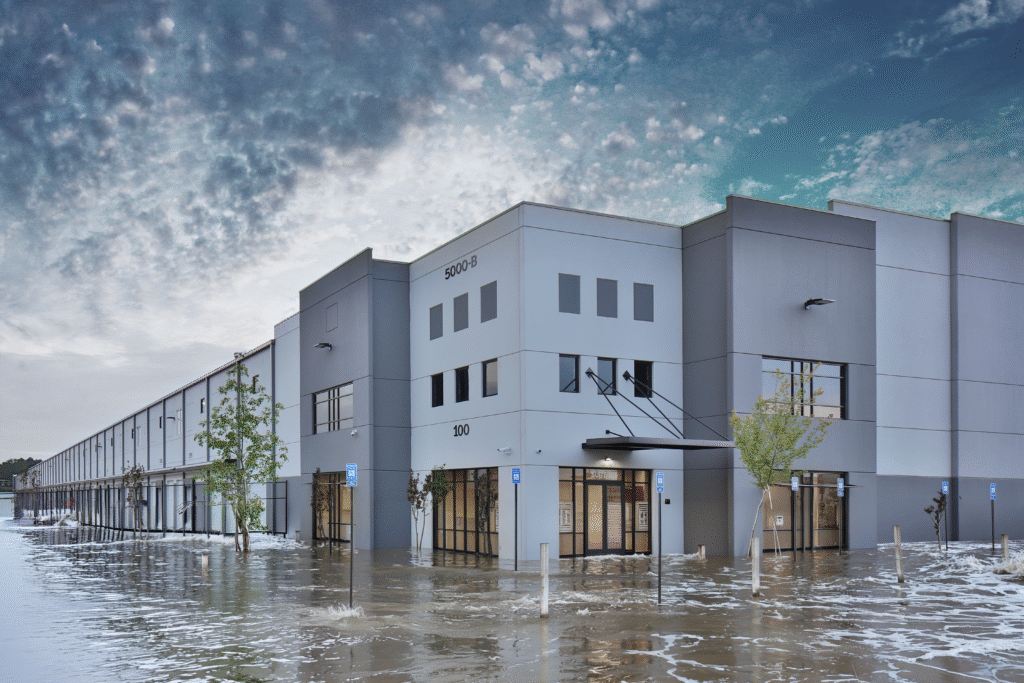
For decades, commercial flood insurance was often viewed as a straightforward purchase. Businesses located within designated flood zones typically secured coverage to satisfy lender requirements, while many outside those areas assumed flood posed little concern.
That framework is becoming increasingly outdated.
Flooding caused more than $8 billion in damage to U.S. homes and businesses in 2024. Nearly $3.9 billion of those losses occurred in communities that are not considered high-risk flood areas, illustrating how flood exposure increasingly extends beyond traditional flood maps.
Nearly $3.9 billion of those losses occurred in communities that are not considered high-risk flood areas...

Flood losses today are being driven by a broader range of events than many businesses have historically associated with flood risk. Inland flooding, flash flooding, severe convective storms, and aging infrastructure are creating losses in areas that have not traditionally been viewed as high-risk. At the same time, increased development, expanding impervious surfaces and rising property values have made flood losses more complex and potentially more costly than they were even a decade ago.
The result is a commercial flood market where businesses are reassessing not only whether they need coverage, but whether traditional approaches to flood insurance still align with today’s risk environment.
A changing risk landscape
One of the clearest examples came in September 2024, when Hurricane Helene moved inland and caused catastrophic flooding throughout western North Carolina. Communities including Asheville experienced unprecedented flooding that damaged infrastructure, disrupted transportation, and left businesses without power, communications and access for weeks.
Events like these are challenging long-held assumptions about where significant flood losses can occur. While coastal flooding remains an important concern, commercial property owners are increasingly recognizing that flood exposure extends well beyond hurricane-prone regions.
The conversation is also expanding beyond whether or not a building itself floods. Businesses are paying closer attention to how surrounding infrastructure, road closures, utility outages and extended recovery periods can affect operations even when direct property damage is limited.
These broader exposures are changing the way brokers and insureds evaluate flood risk.
Why flexibility matters
The National Flood Insurance Program continues to serve an important role, particularly for businesses that must obtain coverage to satisfy federally regulated lender requirements.
However, today’s commercial risks often extend beyond what standardized coverage was originally designed to address.
Private non-admitted flood products have emerged as one way to address those evolving needs. Because they are not subject to the same policy forms and rating requirements as admitted products, they can provide greater underwriting flexibility while still satisfying lender requirements where applicable.
Private non-admitted flood products have emerged as one way to address those evolving needs. Because they are not subject to the same policy forms and rating requirements as admitted products, they can provide greater underwriting flexibility while still satisfying lender requirements where applicable.
That flexibility may include higher available limits than the NFIP, broader definitions of flood, expanded business interruption coverage, ordinance or law coverage, a wider range of deductible options, and the ability to insure multiple locations under a single policy.
Rather than replacing the NFIP in every situation, private flood coverage may complement it by providing excess limits, or in some cases replace it entirely, depending on the insured’s circumstances.
A different conversation with commercial clients
These changes are also influencing the conversations brokers are having with clients.
Historically, many businesses outside designated flood zones declined flood coverage because they perceived little exposure. Today, more clients are asking whether historical flood maps tell the whole story and whether their insurance program reflects today’s operating environment rather than yesterday’s.
Those conversations increasingly include questions about operational resilience, rebuilding timelines, supply chain disruption and business income, in addition to the traditional discussion around property damage.
Another important consideration is insured values.
Inflation, labor shortages and rising construction costs have significantly increased replacement costs across commercial property. Businesses that have not updated property values in several years may discover that coverage limits no longer reflect the true cost to rebuild following a major loss.
For brokers and insureds alike, reviewing values has become an increasingly important part of evaluating flood risk—not simply because flood events are occurring more frequently in many areas, but because the financial consequences of being underinsured have grown substantially.
Meeting a more complex market
As commercial flood exposures continue to evolve, insurance solutions are evolving alongside them.
Businesses today often require more than a standardized policy designed around historic flood assumptions. Some are seeking higher limits to protect larger property schedules. Others are looking for broader coverage or deductible options that better align with their financial strategy and appetite for risk.
That growing demand for flexibility is helping drive increased interest in private, non-admitted flood insurance.
As commercial flood exposures continue to evolve, so too will the insurance solutions designed to address them. For brokers and risk managers, the conversation is no longer simply about whether flood coverage is required, but whether a policy reflects the realities of today’s risk environment. As businesses reassess their flood exposures, flexibility is becoming an increasingly important consideration in building coverage that aligns with their operations, risk tolerance and long-term resilience.