
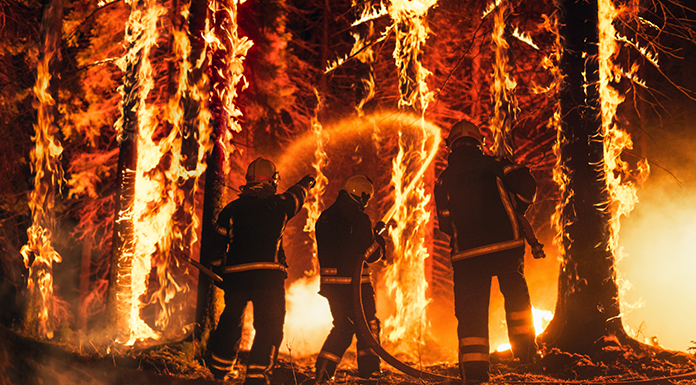

As wildfire seasons grow longer and more intense across the western United States, outdoor workers face increasing risks from smoke exposure. For employers, especially those in construction, agriculture, landscaping, and other outdoor industries, understanding and complying with wildfire smoke safety regulations is essential—not only for regulatory compliance, but also for protecting employee health and productivity.
Understanding the Risk
Wildfire smoke contains a complex mixture of gases and fine particles, primarily Particulate Matter (PM) less than 2.5 micrometers in diameter. These particles can penetrate deep into the lungs and even enter the bloodstream, leading to serious health issues such as respiratory irritation, reduced lung function, and exacerbation of heart and lung diseases.
OSHA’s Position on Wildfire Smoke
While federal OSHA does not yet have a specific standard solely for wildfire smoke, it enforces the General Duty Clause of the Occupational Safety and Health Act, which requires employers to provide a workplace “free from recognized hazards that are causing or are likely to cause death or serious physical harm.”
In response to increasing wildfire events, OSHA has issued guidance urging employers to take proactive steps to protect outdoor workers from poor air quality. These include:
- Monitoring air quality using reliable sources like www.airnow.gov.
- Relocating or rescheduling work to avoid peak smoke conditions.
- Reducing physical exertion during high-smoke periods.
- Providing NIOSH-approved respirators (e.g., N95 masks) for voluntary use.
- Educating workers on the health risks of smoke exposure and how to protect themselves.
When respirators are offered voluntarily, employers must provide workers with the advisory information found in Appendix D of OSHA’s Respiratory Protection Standard (29 CFR 1910.134).
State-Specific Regulations
Some states with OSHA-approved State Plans have gone further by implementing their own wildfire smoke standards:
- California (Cal/OSHA): Requires protective measures when the Air Quality Index (AQI) for PM2.5 exceeds 151, including mandatory respirator use at higher levels.
- Oregon (Oregon OSHA): Enforces permanent rules requiring training, exposure controls, and respirator use based on AQI thresholds.
- Washington (Washington Labor & Industries): Has adopted similar rules to protect workers during wildfire smoke events.
Employers operating in these states must comply with both federal and state-specific requirements.
Best Practices for Employers
To ensure compliance and protect your workforce, ICW Group recommends the following:
- Develop a Wildfire Smoke Response Plan: Include procedures for monitoring air quality, adjusting work schedules, and distributing Personal Protective Equipment (PPE).
- Train Supervisors and Employees: Make sure everyone understands the signs of smoke-related illness and how to respond. Utilize ICW Group’s proprietary Safety OnDemand toolkit to train employees on Wildfire Smoke.
- Maintain a Supply of Respirators: Stock NIOSH-approved masks and ensure they are available when needed.
- Document Your Efforts: Keep records of air quality monitoring, training sessions, and PPE distribution to demonstrate compliance.
Wildfire smoke is a growing occupational hazard, but with the right planning and protective measures, employers can significantly reduce the risks to their workers. ICW Group is here to support you with resources, training, and expert guidance to help you stay compliant and keep your workforce safe. Contact your dedicated Risk Management Consultant for questions and assistance.
For more information, visit OSHA’s Wildfire Safety page at osha.gov/wildfires.