
Moving boxes, stocking shelves, unloading supplies, and pushing carts are routine tasks, but they can place significant demands on employees’ backs, shoulders, and arms. Manual material handling includes lifting, lowering, carrying, pushing, and pulling. Injuries can result from a single difficult move or develop gradually with repeated exertion. Effective prevention goes beyond reminding employees to “lift properly.” The goal is to redesign the task to require less effort.
Before focusing on lifting technique, look for ways to eliminate or reduce unnecessary manual handling.
Look at the whole task, not just the weight
Walk through the workplace with employees who handle materials. Look for lifting from floor level, overhead reaching, twisting, long carrying distances, poor handholds, and repetitive movements. Ask which tasks are most difficult, and review injury and near-miss reports. Even a light item can create risk when handled frequently or held far from the body. Evaluate the load, posture, frequency, duration, and work environment together rather than relying on a single weight limit.
Reduce the handling before improving the technique
Start with changes that remove or reduce physical demands:
- Bring materials closer. Arrange deliveries and storage near the point of use to reduce carrying and repeated transfers.
- Improve storage height. Place frequently handled materials near waist height when practical. Use lift tables or pallet positioners to reduce bending and reaching.
- Reduce individual loads. Request smaller containers or split contents when feasible, while considering whether additional trips create excessive repetition.
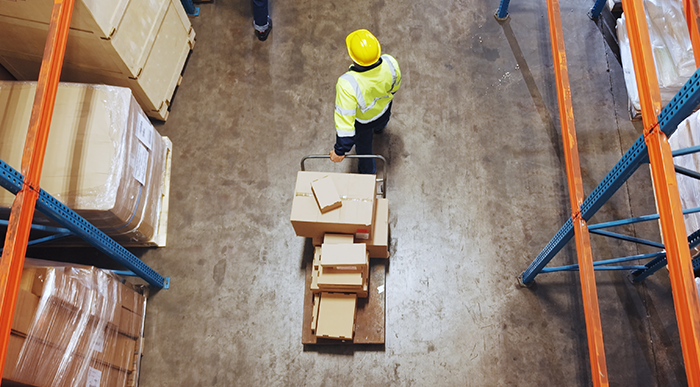
- Provide the right equipment. Use suitable carts, dollies, conveyors, or lift-assist devices. Follow capacity limits and manufacturer instructions and train employees before use.
- Maintain clear routes. Correct clutter, spills, uneven surfaces, and tight turns. Regularly inspect cart wheels and handles because damaged equipment increases the force needed to move a load.
Plan each move and reinforce safer practices
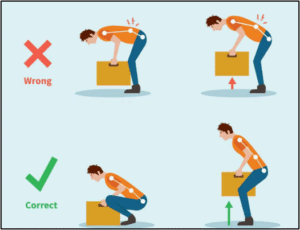
Train employees to plan before moving an item: check its weight, stability, and grip, clear the route, and confirm where it’s going. When manual lifting cannot be avoided, show them how to keep the load close, use a stable stance, bend at the hips and knees as appropriate, and move smoothly. They should turn with their feet instead of twisting their torso. Make clear that if the load is awkward or difficult to control, employees should stop and get the right equipment or help.
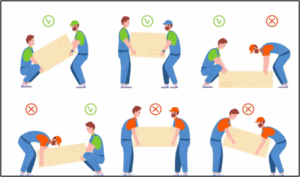
For planned team lifts, set the expectation that employees agree on the route and coordinate their movements before they start. Remember that two people do not automatically make an unsafe task safe, and team lifting should not replace practical mechanical assistance. If a load is still hard to control, reassess the task and use another handling method.
When equipment and the route allow safe control and visibility, encourage employees to push carts rather than pull them, and make sure loads don’t block the operator’s view. If starting, stopping, or steering takes too much effort, reassess the load, equipment, and route rather than encouraging employees to push harder.
Make prevention part of daily operations
Employers should provide hands-on instructions using actual workplace tasks. Confirm that your employees can use equipment correctly and recognize when to ask for help.
Build recovery opportunities into repetitive work. Task rotation is most effective when alternate tasks use different physical demands rather than repeat the same motions elsewhere. Encourage prompt, blame-free reporting of discomfort, strains, soreness, handling difficulties, and near misses. Early reporting allows supervisors to investigate ergonomic concerns and make improvements before a minor issue becomes more serious.
After making changes, ask employees whether the job is easier and check that the improvement has not introduced new hazards.
Put your ICW Group resources to work
ICW Group workers’ compensation policyholders have access to safety resources and risk management services at no additional cost:
- Safety OnDemand®: Access training courses, videos, and ready-to-deliver safety talks, including materials in English and Spanish: Safety OnDemand. Look for safe lifting and ergonomics topics to support toolbox talks and onboarding.
- On-demand webinars: Explore ICW Group’s webinar library, including “Sprains & Strains: Why Your Prevention Efforts Aren’t Working.
- Personalized support: Contact your assigned Risk Management Consultant to discuss manual material handling concerns and potential improvements. Learn about ICW Group’s Risk Management Services or use the ICW Group Contact Us Page and select Safety and Risk Management. For platform assistance, select Safety OnDemand Support.
Take the first step
For additional guidance, review NIOSH’s Ergonomic Guidelines for Manual Material Handling. Start by identifying one task employees find physically demanding and look for practical ways to reduce lifting, carrying, pushing, or pulling forces. Involve employees in the process, measure the results, and continually look for opportunities to improve. Making work easier to perform is one of the most effective ways to make it safer.